
James Madison (1751-1836)
Founding Father & 4th President of the United States (1809-1817)
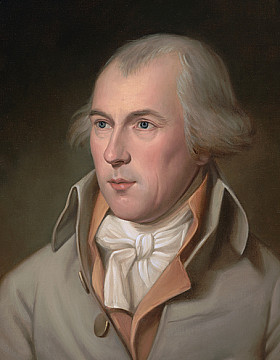
He was preceded in the Presidency by Thomas Jefferson and after serving two terms in office for the Democratic-Republican Party he was succeeded in 1817 by James Monroe. His Vice-President during his first term was George Clinton and for his second term he chose Elbridge Gerry. While Madison was the smallest President in American history (standing at just 5'4"), he stood tall in American history: He was appointed to the Continental Congress, framed the Bill of Rights, and earned the sobriquet, "Father of the Constitution," and that was all before being elected President. Coincidentally, Madison was a cousin of the 12th U.S. President, Zachary Taylor, through their mutual great-grandfather, Colonel James Taylor of Bloomsbury, Virginia.
He was born in Port Conway, Virginia, and was brought up at Montpelier, his father's 5,000-acre tobacco plantation. He graduated from Princeton (then known as the College of New Jersey) where he indulged his taste for academia. He served in the Virginia House of Delegates and the Continental Congress during the 1780s, where he advocated for stronger federal government. He was the primary architect of the Virginia Plan at the 1787 Constitutional Convention and took detailed notes of the proceedings, co-authoring the Federalist Papers with Alexander Hamilton and John Jay to promote ratification. As a U.S. Congressman, he drafted the Bill of Rights and helped establish the first political parties, notably the Democratic-Republican Party. He later served as Thomas Jefferson's Secretary of State (1801-1809), overseeing the Louisiana Purchase. Known as the "Father of the Constitution" for his crucial role in drafting and ratifying the founding document, Madison entered office in 1809 with an unparalleled knowledge of American governance.
In the 1808, he defeated Charles Cotesworth Pinckney of South Carolina to become president. His presidency was dominated by foreign policy crises, particularly tensions with Britain and France during the Napoleonic Wars. His administration initially pursued economic diplomacy through trade embargoes, hoping to pressure European powers to respect American neutrality and maritime rights. However, these measures, including the unpopular Embargo Act inherited from Jefferson, proved economically damaging to American commerce while failing to achieve its diplomatic objectives.
He was born in Port Conway, Virginia, and was brought up at Montpelier, his father's 5,000-acre tobacco plantation. He graduated from Princeton (then known as the College of New Jersey) where he indulged his taste for academia. He served in the Virginia House of Delegates and the Continental Congress during the 1780s, where he advocated for stronger federal government. He was the primary architect of the Virginia Plan at the 1787 Constitutional Convention and took detailed notes of the proceedings, co-authoring the Federalist Papers with Alexander Hamilton and John Jay to promote ratification. As a U.S. Congressman, he drafted the Bill of Rights and helped establish the first political parties, notably the Democratic-Republican Party. He later served as Thomas Jefferson's Secretary of State (1801-1809), overseeing the Louisiana Purchase. Known as the "Father of the Constitution" for his crucial role in drafting and ratifying the founding document, Madison entered office in 1809 with an unparalleled knowledge of American governance.
In the 1808, he defeated Charles Cotesworth Pinckney of South Carolina to become president. His presidency was dominated by foreign policy crises, particularly tensions with Britain and France during the Napoleonic Wars. His administration initially pursued economic diplomacy through trade embargoes, hoping to pressure European powers to respect American neutrality and maritime rights. However, these measures, including the unpopular Embargo Act inherited from Jefferson, proved economically damaging to American commerce while failing to achieve its diplomatic objectives.
The defining moment of Madison's presidency was the War of 1812, often called the "Second War of Independence." Facing British impressment of American sailors, trade restrictions, and suspected British support for Native American resistance on the frontier, Madison reluctantly asked Congress to declare war in June 1812. The conflict exposed serious weaknesses in American military preparedness, culminating in the British burning Washington, D.C. - including the White House - in 1814, forcing Madison and his wife Dolley to flee the capital. Despite military setbacks, the war concluded with the Treaty of Ghent (1814), restoring the pre-war status quo with no territorial changes.
Madison's presidency also saw the controversial recharter of the Bank of the United States in 1816, marking a shift from his earlier strict constructionist views. Domestically, he supported internal improvements and economic development while navigating the growing sectional tensions over slavery's expansion. His presidency ultimately strengthened American sovereignty and national identity, though it revealed the challenges of translating constitutional theory into executive leadership during times of crisis. He retired with the nation more unified and internationally respected than when he assumed office. His - famous - last words were, "I always talk better lying down".
Madison's presidency also saw the controversial recharter of the Bank of the United States in 1816, marking a shift from his earlier strict constructionist views. Domestically, he supported internal improvements and economic development while navigating the growing sectional tensions over slavery's expansion. His presidency ultimately strengthened American sovereignty and national identity, though it revealed the challenges of translating constitutional theory into executive leadership during times of crisis. He retired with the nation more unified and internationally respected than when he assumed office. His - famous - last words were, "I always talk better lying down".


