
Herbert Hoover (1874-1964)
31st President of the United States (1929-1933)
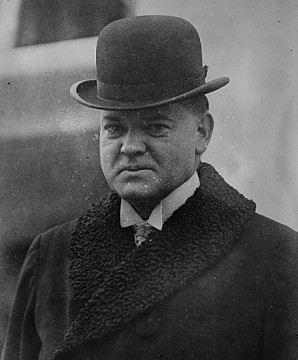
He was preceded in the Presidency by Calvin Coolidge and after serving one term in office for the Republican Party he was succeeded in 1933 by Franklin D. Roosevelt. His Vice-President throughout was Charles Curtis, the first Native American to serve in the United States Congress. Hoover's career spanned engineering, humanitarian work, and politics before culminating in his presidency during one of America's most challenging periods. Born in a modest cottage in West Branch, Iowa, he became a successful mining engineer, working in Australia and China among other countries and accumulating considerable wealth in the process.
He first gained national prominence during World War I, leading massive humanitarian efforts. He organized food relief for German-occupied Belgium, saving millions from starvation, and later directed the U.S. Food Administration, coordinating domestic food production and conservation. After the war, he led European relief efforts, cementing his reputation as "The Great Humanitarian." During the 1920s, he served as Secretary of Commerce under Presidents Harding and Coolidge, promoting business efficiency and voluntary cooperation between government and industry. He championed American economic expansion abroad and supported emerging technologies like radio and aviation. His technocratic approach and progressive Republican views made him a party favorite.
Elected president in 1928 with overwhelming support, Hoover initially appeared well-positioned to continue the decade's prosperity. However, the stock market crash of October 1929 and the ensuing Great Depression defined his presidency. Despite implementing various recovery measures, including the Reconstruction Finance Corporation and public works projects, economic conditions worsened dramatically. His response to the Great Depression proved inadequate and politically damaging. His belief in voluntary cooperation and limited government intervention conflicted with the severity of the crisis. Unemployment soared, banks failed, and "Hoovervilles" - shantytowns named mockingly after the president - sprouted up all across the nation. His perceived indifference to suffering, though largely unfair, became politically toxic and he was defeated decisively by Franklin D. Roosevelt in the 1932 presidential election.
Hoover left office deeply unpopular. However, his post-presidency was remarkably productive. He organized food relief after World War II, chaired government efficiency commissions, and wrote extensively. By his death in 1964, historical assessment of his humanitarian contributions and administrative reforms had begun rehabilitation, though his presidency remained overshadowed by the Depression's devastation. In 1899, he married Lou Henry. They lived between their apartment in New York City and their art-deco home in Stanford, California. They were the parents of two sons.
Hoover left office deeply unpopular. However, his post-presidency was remarkably productive. He organized food relief after World War II, chaired government efficiency commissions, and wrote extensively. By his death in 1964, historical assessment of his humanitarian contributions and administrative reforms had begun rehabilitation, though his presidency remained overshadowed by the Depression's devastation. In 1899, he married Lou Henry. They lived between their apartment in New York City and their art-deco home in Stanford, California. They were the parents of two sons.