
George William Childs (1829-1894)
Co-Owner of the "Public Ledger" & President of Drexel University, Philadelphia
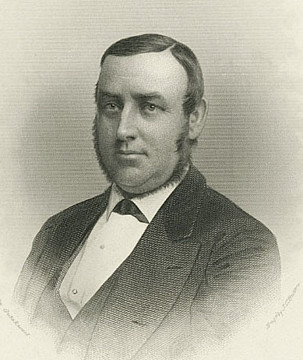
He left Baltimore when he was fourteen and became an errand boy in a bookstore in Philadelphia. Seven years later, he went into the publishing business with his father-in-law, Robert Evans Peterson, and oversaw the publication of Elisha Kent Kane's Expedition to the Arctic. When Peterson retired, he partnered with J.B. Lippincott, but within a year he withdrew from the partnership and returned to his own publishing house. In 1864, Childs purchased The Public Ledger financed by the brothers Francis and Anthony Drexel. Under Childs's direction the newspaper became a highly respected publication, recognized for its responsibly documented attacks on war profiteering and monopolies. The paper's success saw him become a millionaire and a founding trustee and then President of the Drexel Institute of Technology (now Drexel University). Among other philanthropic projects, he and Anthony Drexel built one of the country's first planned suburban communities, Wayne, Pennsylvania - a clean, small, suburban town, with wide streets and affordable housing for people with modest incomes. Drexel's son, George William Childs Drexel, succeeded him as owner of the Public Ledger.
He and his wife lived between their townhouse in Philadelphia, their country home "Wootton" in Bryn Mawr, and their summer home in Long Branch, New Jersey, that was adjecent to that of his close friend, Gen. Ulysses S. Grant. All his homes and his offices were filled with Japanese bamboo and jade carvings, cloisonné, Sèvres china, and Moorish and English silver. He owned the desk on which Lord Byron wrote Don Juan and collected rare books and manuscripts. Among the treasures in his library was a handwritten sermon by Cotton Mather dated 1703, his friend Edgar Allan Poe's manuscript of The Murders in the Rue Morgue (1841), and the original manuscript of Charles Dickens's Our Mutual Friend (1865). His most prized possession was a massive folio containing signed letters and portraits of every U.S. President from George Washington to Benjamin Harrison.
He and his wife lived between their townhouse in Philadelphia, their country home "Wootton" in Bryn Mawr, and their summer home in Long Branch, New Jersey, that was adjecent to that of his close friend, Gen. Ulysses S. Grant. All his homes and his offices were filled with Japanese bamboo and jade carvings, cloisonné, Sèvres china, and Moorish and English silver. He owned the desk on which Lord Byron wrote Don Juan and collected rare books and manuscripts. Among the treasures in his library was a handwritten sermon by Cotton Mather dated 1703, his friend Edgar Allan Poe's manuscript of The Murders in the Rue Morgue (1841), and the original manuscript of Charles Dickens's Our Mutual Friend (1865). His most prized possession was a massive folio containing signed letters and portraits of every U.S. President from George Washington to Benjamin Harrison.