
George Pollock (1762-1820)
J.P., Merchant, of New York City & afterwards of New Orleans, Louisiana
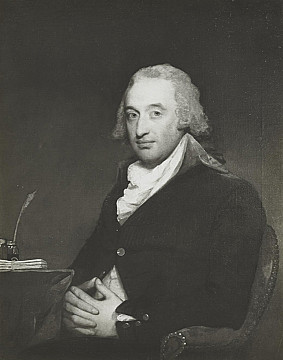
He was a nephew of Oliver Pollock who was the first of his family to come to America (Philadelphia) and gave the equivalent of several million dollars to the Revolutionary cause. George came to New York from Northern Ireland as an importer of Irish linen. He lived at 26 Whitehall Street and kept a store at 95 Front Street. He was President of the Friendly Sons of St. Patrick (1796) and in 1795 he purchased land on the east bank of the Hudson from Nicholas de Peyster, on which he built his country home "Monte Alta" roughly where Riverside Drive in Bloomingdale is found today. Having been one of New York's wealthiest merchants, he was ruined after several of his ships were captured during the Quasi War with France. To escape bankruptcy, he moved to New Orleans in 1803 where he became a Justice of the Peace for the County of Orleans, and it was before him that General James Wilkinson made his affidavit against Aaron Burr (Dec. 26, 1806). He was also a member of the Grand Jury that indicted General Wilkinson for the arrest of Peter V. Ogden in 1807. He had five children by his first wife (daughter of his business partner, Richard Yates) and two more by his second wife, Maria Herrera. His granddaughter was the wife of Admiral David Dixon Porter who won fame at Vicksburg.
He sold off a portion of his country estate to Gulian Verplanck, and later, to his widow Cornelia Verplanck. In 1806, Michael Hogan, a native of County Clare in Ireland, purchased the land from the executors of the estate of Gulian Verplanck and named it "Claremont". In 1821, Hogan conveyed the property to Joel Post, to whose heirs the property belonged when it was taken by the city for a public park.
He sold off a portion of his country estate to Gulian Verplanck, and later, to his widow Cornelia Verplanck. In 1806, Michael Hogan, a native of County Clare in Ireland, purchased the land from the executors of the estate of Gulian Verplanck and named it "Claremont". In 1821, Hogan conveyed the property to Joel Post, to whose heirs the property belonged when it was taken by the city for a public park.
Parents (2)

Spouses (2)

Children (7)


Categories
Share
Image Courtesy of the Frick Art Reference Library
https://daytoninmanhattan.blogspot.com/2017/07/the-lost-claremont-inn-riverside-dr-and.html
https://daytoninmanhattan.blogspot.com/2017/07/the-lost-claremont-inn-riverside-dr-and.html