
Gen. John Henry Hammond (1833-1890)
Brigadier General in the Union Army, Railroad Organizer & Founder of West Superior
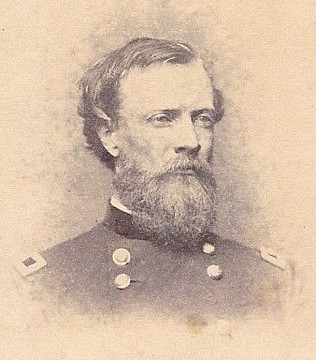
He was born in New York City in the same year that his father died and his Irish-born mother moved to Campbell County, Kentucky. He was educated in Bethany, Virginia, and attended Jesuit College in Cincinnati (1847-51) where he studied civil engineering. After leaving college he worked in New York for two years, returned to the family farm for another year, then went to Clinton, Iowa from October of 1854 to 1857. That year he went to Europe intending to complete his education and learn about the wine industry but he returned after a year due to the death of his mother. He travelled out west to California, but on the outbreak of the Civil War, he was commissioned as a 2nd Lieutenant in the 5th California Infantry in 1861. By December, he had risen to the rank of Major and was serving as Adjutant-General and Chief of Staff to General W.T. Sherman, retiring with the rank of Brevet Brigadier General.
After the war, he settled in Missouri and became President of the Chillicothe & Brunswick Railroad. Soon after he organized the St. Louis, Council Bluff, & Omaha Railroad, remaining president of both companies until 1874 when ill health induced him to seek a northern climate. From 1875 to 1882 he lived in Evanston, Illinois, becoming president of a bank and an inspector for the Department of the Interior. Official duties frequently took him through the Upper Midwest and North Dakota, prompting him to conclude that the area around Duluth-Superior, at the head of the Great Lakes, was ripe for settlement.
After the war, he settled in Missouri and became President of the Chillicothe & Brunswick Railroad. Soon after he organized the St. Louis, Council Bluff, & Omaha Railroad, remaining president of both companies until 1874 when ill health induced him to seek a northern climate. From 1875 to 1882 he lived in Evanston, Illinois, becoming president of a bank and an inspector for the Department of the Interior. Official duties frequently took him through the Upper Midwest and North Dakota, prompting him to conclude that the area around Duluth-Superior, at the head of the Great Lakes, was ripe for settlement.
From 1879, he began to purchase substantial quantities of land across the bay from Duluth and two miles west of Old Superior, a territory later known as West Superior. In 1882, he moved to St. Paul, Minnesota, where he persuaded nine investors to join him in a plan to purchase land to the value of $100,000. To facilitate the venture, he incorporated the Land & River Improvement Company (LRIC) which under his management and the presidency of Robert Belknap purchased, cleared, platted, improved and promoted a new townsite. The company immediately became the largest real estate, investment and development firm in West Superior, Wisconsin, and Hammond became the single most influential individual in the town's development as an urban commercial center, building industrial docks, elevators, and railroads too. He established the Lake Superior Terminal & Transit Railway Company (1883) and the Duluth, South Shore & Atlantic Railway (1888), providing a direct route to eastern markets that avoided both Chicago and the problem of lake shipping in wintertime. In 1864, he married Sophia Wolfe of Louisville, Kentucky, and had 7-children.