
Gen. George S. Patton (1885-1945)
"Old Blood & Guts" Commander of the Third Army in France & Germany (1944-45)
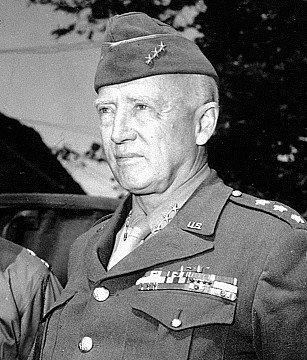
He was born at Lake Vineyard Ranch that is better known today as San Gabriel, California. He graduated from West Point in 1909 and served in the cavalry, gaining valuable military experience in the 1916 Mexican Expedition under General Pershing. During World War I, as the Commander of the U.S. Tank Corps in France, he pioneered American tank warfare, earning the Distinguished Service Cross for his leadership at the Meuse-Argonne Offensive, where he was wounded. Between the wars, he remained an advocate of armored warfare despite the army's limited interest. He studied tank tactics extensively and published influential writings on mechanized combat.
On the outbreak of World War II, he was given command of the 2nd Armored Division and later I Armored Corps. In 1942, he led American forces in Operation Torch, the invasion of North Africa. After the American defeat at Kasserine Pass, he took command of II Corps, restoring discipline and morale before participating in the Tunisia Campaign. In 1943, he commanded the 7th Army during the invasion of Sicily, racing British forces to Messina. However, two incidents where he slapped shell-shocked soldiers nearly ended his career, sidelining him temporarily. Nonetheless, he rebounded spectacularly in 1944, commanding the Third Army through France after D-Day. His aggressive, mobile warfare tactics led to rapid advances across France. During the Battle of the Bulge, he executed a remarkable maneuver, pivoting his army north to relieve besieged Bastogne within days. Patton's Third Army drove deep into Nazi Germany in 1945, reaching Czechoslovakia by the war's end in September, 1945. Having survived two world wars, he was killed just three months later from injuries sustained in a car accident in Germany. He married and had 3-children.
On the outbreak of World War II, he was given command of the 2nd Armored Division and later I Armored Corps. In 1942, he led American forces in Operation Torch, the invasion of North Africa. After the American defeat at Kasserine Pass, he took command of II Corps, restoring discipline and morale before participating in the Tunisia Campaign. In 1943, he commanded the 7th Army during the invasion of Sicily, racing British forces to Messina. However, two incidents where he slapped shell-shocked soldiers nearly ended his career, sidelining him temporarily. Nonetheless, he rebounded spectacularly in 1944, commanding the Third Army through France after D-Day. His aggressive, mobile warfare tactics led to rapid advances across France. During the Battle of the Bulge, he executed a remarkable maneuver, pivoting his army north to relieve besieged Bastogne within days. Patton's Third Army drove deep into Nazi Germany in 1945, reaching Czechoslovakia by the war's end in September, 1945. Having survived two world wars, he was killed just three months later from injuries sustained in a car accident in Germany. He married and had 3-children.