
Gen. Arthur St. Clair (1737-1818)
President of the Confederation Congress & 1st Governor of the Northwest Territory
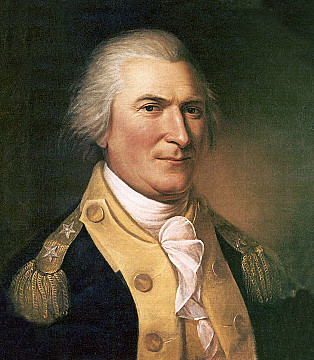
He was born in Scotland at Thurso, Caithness. In 1757, he was commissioned as an Ensign into the 60th Royal American Regiment and fought at Louisburg (1758) and under Wolfe at the Battle of Quebec (1759). Promoted to Lieutenant in 1759, he resigned his commission in 1762 having spent the previous two years on leave in Boston where he was married in 1760. Investing in property on Boston's Hollis Street, he took up residence at Braintree before moving to Pennsylvania where he purchased an estate of 10,881-acres in the Ligonier Valley. In 1770, he was appointed Surveyor for the District of Cumberland, and a Member of Governor Richard Penn's Provincial Council.
In 1776, St. Clair accepted a commission into the Continental Army as Colonel of the 3rd Pennsylvania Regiment. Months later, he was promoted to Brigadier-General and was tasked by George Washington to help train and equip new recruits. He was with Washington as they crossed the Delaware River before the Battle of Trenton and he is generally credited for the strategy that led to the capture of Princeton in January, 1777. Promoted to Major-General in February, he was given command of Fort Ticonderoga where in 1778 his decision to evacuate his men - rather than stand ground and fight - severely damaged his reputation. He was court-martialled and although exonerated he was never given another command during the Revolution. Nonetheless, he returned to active service as aide-de-camp to Washington who continued to hold him in high regard.
After the war was won, St. Clair left the army and in 1785 he was elected to the Confederation Congress. In 1787, his peers elected him to a one-year term as President of the Continental Congress - the only foreign-born "president" of the United States. In the same year he was appointed the 1st Governor of the newly created Northwest Territory (modern-day Ohio, Indiana, Illinois, Michigan, Wisconsin and part of Minnesota) and he named the city of Cincinnati to honor his membership in the Society of the Cincinnati.
In 1776, St. Clair accepted a commission into the Continental Army as Colonel of the 3rd Pennsylvania Regiment. Months later, he was promoted to Brigadier-General and was tasked by George Washington to help train and equip new recruits. He was with Washington as they crossed the Delaware River before the Battle of Trenton and he is generally credited for the strategy that led to the capture of Princeton in January, 1777. Promoted to Major-General in February, he was given command of Fort Ticonderoga where in 1778 his decision to evacuate his men - rather than stand ground and fight - severely damaged his reputation. He was court-martialled and although exonerated he was never given another command during the Revolution. Nonetheless, he returned to active service as aide-de-camp to Washington who continued to hold him in high regard.
After the war was won, St. Clair left the army and in 1785 he was elected to the Confederation Congress. In 1787, his peers elected him to a one-year term as President of the Continental Congress - the only foreign-born "president" of the United States. In the same year he was appointed the 1st Governor of the newly created Northwest Territory (modern-day Ohio, Indiana, Illinois, Michigan, Wisconsin and part of Minnesota) and he named the city of Cincinnati to honor his membership in the Society of the Cincinnati.
In 1791, he resumed his rank (Major-General) within the newly created U.S. Army and ordered the construction of Fort Jefferson in Ohio. However, his military reputation was again left in tatters after he and his men were routed at the Battle of Wabash (also referred to as "St. Clair's Defeat" or "The Battle of a Thousand Slain") by a war party of Indians led by Little Turtle and Blue Jacket. He was again exonerated in court but resigned his commission in 1792 at the request of President Washington. Ten years later in 1802, his opposition to Ohio becoming a state led to a clash with President Jefferson which saw him replaced by Charles Willing Byrd as Governor of the Northwest Territory.
St. Clair was both a member of the American Philosophical Society and one of the original members of the Society of the Cincinnati. On May 14th, 1760, at Trinity Church, Boston, he married Phoebe Bayard, a niece of James Bowdoin, Governor of Massachusetts, who brought with her a dowry of $14,000. They were the parents of seven children (listed). After 1779, they lived at Plattstown, Pennsylvania, before returning to Chestnut Ridge in the Ligonier Valley where he died at the home of his daughter, Mrs. Louisa Robb.