
Gen. Ambrose E. Burnside (1824-1881)
Major-General in the Union Army; U.S. Senator & 30th Governor of Rhode Island
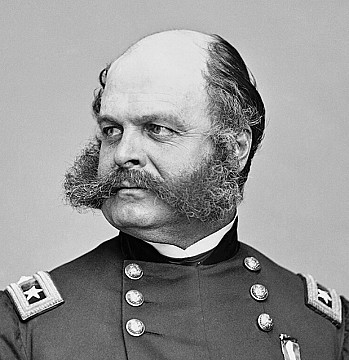
He was born Ambrose Everts Burnside in Liberty, Indiana, and graduated from West Point Military Academy in 1847. He served in the Mexican-American War (1846-48) and later on the frontier before resigning from the army in 1853 to manufacture a breechloading rifle of his own design. When his firearm business failed, he gained employment with the Illinois Central Railroad where he befriended George B. McClellan. On the outbreak of Civil War in 1861, he signed up with the Union Army and quickly rose through the ranks. He commanded a brigade at First Bull Run, then led successful expeditions along the North Carolina coast in early 1862, earning promotion to Major-General. He commanded a corps at Antietam, where his delayed assault on a stone bridge - later named Burnside's Bridge - proved costly when it became a deadly bottleneck.
In 1862, despite Burnside's reservations about his own abilities, Lincoln made him Commander of the Army of the Potomac in place of General McClellan. He led the disastrous Battle of Fredericksburg (1862), where Union forces suffered devastating losses in futile frontal assaults against entrenched Confederate positions. The defeat, followed by the failed "Mud March," led to his removal from command. His next command was over the Department of the Ohio and then the Ninth Corps, participating in the Overland Campaign. But, at the Battle of the Crater in 1864, another poorly executed assault under his watch resulted in heavy casualties and his relief from field command altogether.
After the war, he served three terms as Governor of Rhode Island (1866-69) and was U.S. Senator from Rhode Island from 1875 until his death in 1881. He was the first President of the National Rifle Association and his name coupled with his distinctive facial hair inspired the term "sideburns." In 1852, he married Mary, daughter of Capt. Nathaniel Bishop, of Providence, R.I. After the Civil War, they built (see images) 317 Benefit Street in Providence and lived between there and Edghill Farm in Bristol. He died without children.
After the war, he served three terms as Governor of Rhode Island (1866-69) and was U.S. Senator from Rhode Island from 1875 until his death in 1881. He was the first President of the National Rifle Association and his name coupled with his distinctive facial hair inspired the term "sideburns." In 1852, he married Mary, daughter of Capt. Nathaniel Bishop, of Providence, R.I. After the Civil War, they built (see images) 317 Benefit Street in Providence and lived between there and Edghill Farm in Bristol. He died without children.