Frederick Christ Trump (1905-1999)
of "Elizabeth Trump & Son" Real Estate Developer, of Queens, New York
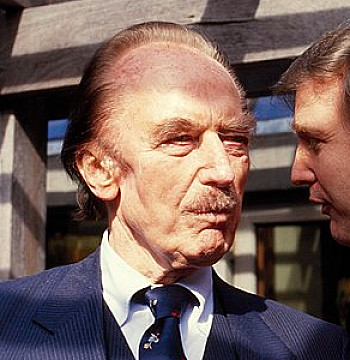
He was born in New York City at 539 East 177th Street in The Bronx. Fred's father died when he was thirteen by which time they were living in a 7-room house in Queens and although they were a German-speaking family, he preferred to tell people they were Swedish. As a teenager in the 1920s, he began working as a carpenter for his mother in their modest construction business, and in 1927 he was one of seven men, reportedly in Klan attire, arrested (and released) at a Ku Klux Klan rally in Queens. "Elizabeth Trump & Son" specialized in building cheap single-family homes primarily in Queens and Brooklyn. During the Depression of the 1930s, they capitalized on government foreclosures and construction opportunities which allowed them to expand into building apartment complexes, still aimed at providing housing for lower income families.
He did not serve during World War II, receiving deferments from military service that allowed him to stay at home, growing the family business significantly which included securing federal contracts to build housing for naval personnel. Moving from lower income to middle class families, he continued to build thousands of apartments in New York's outer boroughs, establishing himself as one of the state's most successful real estate developers. In 1950, Fred moved his family into a 23-room, 9-bathroom mansion with a pillared portico constructed by his firm on two building lots at 85-14 Midland Parkway in Queens (click on this link to Untapped New York for images). He and his wife, Scots-born Mary MacLeod (married 1936), lived there for the remainder of their lives.
In 1971, Fred gave control of the company to his son, Donald, who renamed it the "Trump Organization" and shifted the focus from middle/working-class housing to luxury real estate. However, despite the image Donald liked to portray, by 1990 the organization was in serious financial trouble. By 1995, Donald was reporting an annual loss of $916-million and having defaulted on over $3 billion of bank loans, the company underwent a "vast and humiliating restructuring." Fred actively assisted Donald through this crisis by providing loans, guarantees, and financial support which spared Donald from personal bankruptcy.
In contrast to his son, Fred had always maintained a conservative, low-risk approach to business so while Donald's high-profile properties in Manhattan and elsewhere were failing, Fred continued to retain a considerable and steady rental income from the thousands of rent-stabilized apartments he owned in Queens and Brooklyn. He was diagnosed with Alzheimer's Disease in the 1990s, leading to his death from pneumonia. Despite his son's financial failures, he died with a fortune estimated at $250-300 million.
He did not serve during World War II, receiving deferments from military service that allowed him to stay at home, growing the family business significantly which included securing federal contracts to build housing for naval personnel. Moving from lower income to middle class families, he continued to build thousands of apartments in New York's outer boroughs, establishing himself as one of the state's most successful real estate developers. In 1950, Fred moved his family into a 23-room, 9-bathroom mansion with a pillared portico constructed by his firm on two building lots at 85-14 Midland Parkway in Queens (click on this link to Untapped New York for images). He and his wife, Scots-born Mary MacLeod (married 1936), lived there for the remainder of their lives.
In 1971, Fred gave control of the company to his son, Donald, who renamed it the "Trump Organization" and shifted the focus from middle/working-class housing to luxury real estate. However, despite the image Donald liked to portray, by 1990 the organization was in serious financial trouble. By 1995, Donald was reporting an annual loss of $916-million and having defaulted on over $3 billion of bank loans, the company underwent a "vast and humiliating restructuring." Fred actively assisted Donald through this crisis by providing loans, guarantees, and financial support which spared Donald from personal bankruptcy.
In contrast to his son, Fred had always maintained a conservative, low-risk approach to business so while Donald's high-profile properties in Manhattan and elsewhere were failing, Fred continued to retain a considerable and steady rental income from the thousands of rent-stabilized apartments he owned in Queens and Brooklyn. He was diagnosed with Alzheimer's Disease in the 1990s, leading to his death from pneumonia. Despite his son's financial failures, he died with a fortune estimated at $250-300 million.