
Field Marshal Lord Frederick Sleigh Roberts, 1st Earl Roberts (1832-1914)
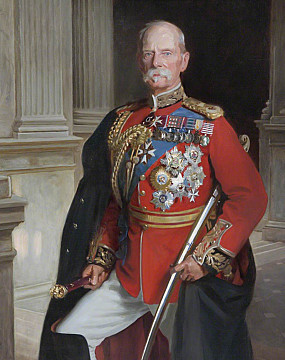
Field Marshal Frederick Sleigh Roberts, 1st Earl Roberts (30 September 1832 – 14 November 1914), was a British Victorian era general who became one of the most successful British military commanders of his time. Born in India to an Anglo-Irish family, Roberts joined the East India Company Army and served as a young officer in the Indian Rebellion during which he was awarded the Victoria Cross for gallantry. He was then transferred to the British Army and fought in the Expedition to Abyssinia and the Second Anglo-Afghan War, in which his exploits earned him widespread fame. Roberts would go on to serve as the Commander-in-Chief, India, before leading British forces for a year during the Second Boer War. He also became the last Commander-in-Chief of the Forces before the post was abolished in 1904.
A man of small stature, Roberts was affectionately known to his troops and the wider British public as "Bobs" and revered as one of Britain's leading military figures at a time when the British Empire reached the height of its power.[1] He became a symbol for the British Army and in later life became an influential proponent of stronger defence in response to the increasing threat that the German Empire posed to Britain in the lead-up to the First World War.
Born at Cawnpore, India, on 30 September 1832, Roberts was the son of General Sir Abraham Roberts,[3] who had been born into an Anglo-Irish family in County Waterford in the south-east of Ireland.[3] At the time, Sir Abraham was commanding the 1st Bengal European Regiment.[4] Roberts was named Sleigh in honour of the garrison commander, Major General William Sleigh.[3] His mother was Edinburgh-born Isabella Bunbury,[3] daughter of Major Abraham Bunbury from Kilfeacle in County Tipperary.[5]
Born at Cawnpore, India, on 30 September 1832, Roberts was the son of General Sir Abraham Roberts,[3] who had been born into an Anglo-Irish family in County Waterford in the south-east of Ireland.[3] At the time, Sir Abraham was commanding the 1st Bengal European Regiment.[4] Roberts was named Sleigh in honour of the garrison commander, Major General William Sleigh.[3] His mother was Edinburgh-born Isabella Bunbury,[3] daughter of Major Abraham Bunbury from Kilfeacle in County Tipperary.[5]
Roberts was educated at Eton,[3] Sandhurst,[3] and Addiscombe Military Seminary[3] before entering the East India Company Army as a second lieutenant with the Bengal Artillery on 12 December 1851.[3] He became Aide-de-Camp to his father in 1852, transferred to the Bengal Horse Artillery in 1854 and was promoted to lieutenant on 31 May 1857.
Roberts fought in the Indian Rebellion of 1857, seeing action during the siege and capture of Delhi where he was slightly wounded, and found a dying John Nicholson amidst the chaos of the battle.[7] He was then present at the relief of Lucknow where, as Deputy Assistant Quartermaster-General, he was attached to the staff of Sir Colin Campbell, Commander-in-Chief, India.[3] He was awarded the Victoria Cross for actions on 2 January 1858 at Khudaganj.[3] The citation reads:
Roberts fought in the Indian Rebellion of 1857, seeing action during the siege and capture of Delhi where he was slightly wounded, and found a dying John Nicholson amidst the chaos of the battle.[7] He was then present at the relief of Lucknow where, as Deputy Assistant Quartermaster-General, he was attached to the staff of Sir Colin Campbell, Commander-in-Chief, India.[3] He was awarded the Victoria Cross for actions on 2 January 1858 at Khudaganj.[3] The citation reads:
Lieutenant Roberts' gallantry has on every occasion been most marked.
On following the retreating enemy on 2 January 1858, at Khodagunge, he saw in the distance two Sepoys going away with a standard. Lieutenant Roberts put spurs to his horse, and overtook them just as they were about to enter a village. They immediately turned round, and presented their muskets at him, and one of the men pulled the trigger, but fortunately the caps snapped, and the standard-bearer was cut down by this gallant young officer, and the standard taken possession of by him. He also, on the same day, cut down another Sepoy who was standing at bay, with musket and bayonet, keeping off a Sowar. Lieutenant Roberts rode to the assistance of the horseman, and, rushing at the Sepoy, with one blow of his sword cut him across the face, killing him on the spot.[8]
He was also mentioned in despatches for his service at Lucknow in March 1858.[9] In common with other officers, he transferred from the East India Company Army to the Indian Army that year.[6]
Having been promoted to second captain on 12 November 1860[10] and to brevet major on 13 November 1860,[11] Roberts transferred to the British Army in 1861 and served in the Umbeyla and Abyssinian campaigns of 1863 and 1867–1868 respectively.[3] Having been promoted to brevet lieutenant colonel on 15 August 1868[12] and to the substantive rank of captain on 18 November 1868,[13] Roberts also fought in the Lushai campaign of 1871–1872 which was directed at the chiefs Vonolel, Lalbura and Bengkhuaia to recover the captive Mary Winchester.[3][14]
He was promoted to the substantive rank of major on 5 July 1872,[15] appointed Companion of the Order of the Bath (CB) on 10 September 1872[16] and promoted to brevet colonel on 30 January 1875.[17] That year he became Quartermaster-General of the Bengal Army.[12]
He was given command of the Kurram Valley Field Force in October 1878 and took part in the Second Anglo-Afghan War.[18] For his success at the Battle of Peiwar Kotal in December 1878, he received the thanks of Parliament, was promoted to the substantive rank of major general on 31 December 1878[19] and was advanced to Knight Commander of the Order of the Bath (KCB) on 25 July 1879.[20]
The Treaty of Gandamak of May 1879 brought peace with Afghanistan. However, after the murder of Sir Louis Cavagnari, the British envoy in Kabul, in September 1879, the second phase of the war began.[12] Roberts was put in command of the Kabul Field Force and despatched to Kabul to seek retribution. After victory at the Battle of Charasiab on 6 October 1879, Roberts occupied Kabul,[3] and was given the local rank of lieutenant-general on 11 November 1879.[21] In December 1879, Roberts' force was besieged in the Sherpur Cantonment outside Kabul until, on 23 December, he repulsed a mass attack and reoccupied the city.[3] In May 1880, Lieutenant General Sir Donald Stewart arrived in Kabul from Kandahar with a further 7,200 troops, taking over the Kabul command from Roberts.[22]
After the defeat of a British brigade at Maiwand near Kandahar on 27 July 1880, Roberts was appointed commander of the Kabul and Kandahar Field Force. He led his 10,000 troops across 300 miles of rough terrain to relieve Kandahar and defeat Ayub Khan at the Battle of Kandahar on 1 September 1880.[3] For his services, Roberts again received the thanks of Parliament, and was advanced to Knight Grand Cross of the Order of the Bath (GCB) on 21 September 1880[23] and appointed Companion of the Order of the Indian Empire (CIE) during 1880.[24]
After a very brief interval as Governor of Natal and Governor and Commander-in-Chief of the Transvaal Province and High Commissioner for South Eastern Africa with effect from 7 March 1881,[25] Roberts, having become a baronet on 11 June 1881,[26] was appointed Commander-in-Chief of the Madras Army on 16 November 1881.[27] Promoted to the substantive rank of lieutenant general on 26 July 1883,[28] he became Commander-in-Chief, India, on 28 November 1885[29] and was advanced to Knight Commander of the Order of the Indian Empire (KCIE) on 15 February 1887[30] and to Knight Grand Commander of the Order of the Indian Empire (GCIE) on reorganisation of the Order on 21 June 1887.[31] This was followed by his promotion to a supernumerary general on 28 November 1890[32] and to the substantive rank of general on 31 December 1891.[33] On 23 February 1892, he was created Baron Roberts, of Kandahar in Afghanistan and of the City of Waterford.[34]
After a very brief interval as Governor of Natal and Governor and Commander-in-Chief of the Transvaal Province and High Commissioner for South Eastern Africa with effect from 7 March 1881,[25] Roberts, having become a baronet on 11 June 1881,[26] was appointed Commander-in-Chief of the Madras Army on 16 November 1881.[27] Promoted to the substantive rank of lieutenant general on 26 July 1883,[28] he became Commander-in-Chief, India, on 28 November 1885[29] and was advanced to Knight Commander of the Order of the Indian Empire (KCIE) on 15 February 1887[30] and to Knight Grand Commander of the Order of the Indian Empire (GCIE) on reorganisation of the Order on 21 June 1887.[31] This was followed by his promotion to a supernumerary general on 28 November 1890[32] and to the substantive rank of general on 31 December 1891.[33] On 23 February 1892, he was created Baron Roberts, of Kandahar in Afghanistan and of the City of Waterford.[34]
Lord Roberts became the last Commander-in-Chief of the Forces on 3 January 1901.[59] During his time in office he introduced the Short Magazine Lee Enfield Rifle and the 18-pounder gun and provided improved education and training for his soldiers.[60] In September 1902, Lord Roberts and St John Brodrick, Secretary of State for War, visited Germany to attend the German army manoeuvres as guest of the Emperor Wilhelm.[61] He served as Commander-in-Chief for three years before the post was abolished as recommended by Lord Esher in the Esher Report in February 1904.[3]
He was the initial president of the Pilgrims Society during 1902.[62]
A frequent visitor to Bath, he was made an Honorary Member of the Bath and County Club, founded in 1858, the year he won the Victoria Cross in the Indian Mutiny.[63]