
Dwight D. Eisenhower (1890-1969)
General "Ike" Eisenhower, 34th President of the United States (1953-1961)
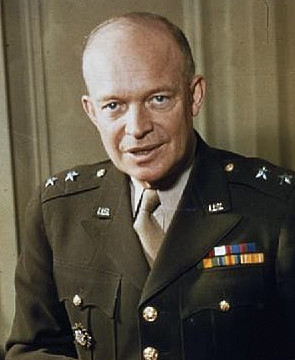
He was preceded in the Presidency by Harry S. Truman and after serving two terms in office for the Republican Party he was succeeded in 1961 by John F. Kennedy. His Vice-President throughout was Richard Nixon whose daughter married his grandson. His career spanned both senior military service and the presidency, marking him as one of America's most consequential 20th-century leaders. He was born in Denison, Texas, but for the most part of his childhood grew up in Abilene, Kansas. He graduated from West Point in 1915, served in World War I, and spent the interwar years in various military roles, developing his strategic thinking and leadership skills.
The Second World War transformed Eisenhower from a relatively obscure colonel into a global figure. As Supreme Allied Commander in Europe, he orchestrated the complex D-Day invasion of Normandy in June 1944, demonstrating exceptional organizational abilities and diplomatic skill in managing the fractious Allied coalition. His leadership during the liberation of Western Europe established him as a national hero and positioned him for postwar prominence. After the war, he served as Army Chief of Staff and later as NATO's first Supreme Allied Commander, helping to build the Western alliance during the early Cold War. Despite lacking prior political experience, his immense popularity led both parties to court him for the presidency, and he won the 1952 election as a Republican.
Serving two terms, his presidency was characterized by relative peace and prosperity, though marked by Cold War tensions. He ended the Korean War, maintained nuclear deterrence while avoiding direct military conflicts, and presided over significant domestic developments including the Interstate Highway System and the beginning of the civil rights movement. His approach emphasized fiscal responsibility and limited government intervention. Eisenhower's leadership style combined military discipline with political pragmatism. He often worked behind the scenes, projecting an image of grandfatherly calm while skilfully managing complex domestic and international challenges. His farewell address warned against the emergence of a "military-industrial complex," meaning the potential dangers of the close relationship between America's military establishment and its defense industry which could push the country towards conflicts that served the financial interests of defense companies rather than genuine national security needs.
Serving two terms, his presidency was characterized by relative peace and prosperity, though marked by Cold War tensions. He ended the Korean War, maintained nuclear deterrence while avoiding direct military conflicts, and presided over significant domestic developments including the Interstate Highway System and the beginning of the civil rights movement. His approach emphasized fiscal responsibility and limited government intervention. Eisenhower's leadership style combined military discipline with political pragmatism. He often worked behind the scenes, projecting an image of grandfatherly calm while skilfully managing complex domestic and international challenges. His farewell address warned against the emergence of a "military-industrial complex," meaning the potential dangers of the close relationship between America's military establishment and its defense industry which could push the country towards conflicts that served the financial interests of defense companies rather than genuine national security needs.
Eisenhower's legacy encompasses both his wartime heroism and his steady presidential leadership during a pivotal period in American history, establishing him as a figure who successfully bridged military and civilian leadership roles. In 1916, he married Mamie Doud and they had two children, only one of whom survived to adulthood.