
David Abeel (1763-1840)
Ship's Captain of New York City & Midshipman in the Continental Navy
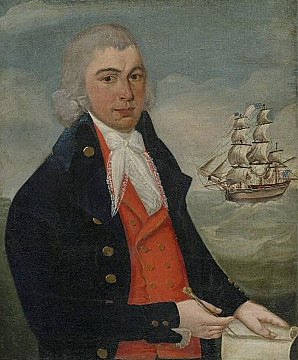
He showed an early interest in a life at sea and volunteered to serve with Captain Barry on the ship Governor General, which sailed under letters of marquee during the Revolution. He made a voyage to St. Eustatius in the Dutch West Indies in 1780, which lasted several months, before being appointed Midshipman on the frigate Alliance which took Col. Laurens to France in early 1781. After leaving France and cruising near the West Indies, the Alliance was attacked on the 28th May by the British sloops-of-war Atalanta and Tripassa. All three vessels were becalmed at the beginning of the action, the Alliance in consequence of her position being at a great disadvantage. Captain Barry was wounded early in the action and carried below, and the British made demand for the surrender of his ship, but a sudden breeze coming up at the moment the Alliance ran between the two British vessels, pouring a broadside from her starboard and larboard guns at the same time, disabling her antagonists and compelling their surrender. Midshipman Abeel was wounded in the thigh during the action by a musket ball.
On reaching New York, Abeel received the public thanks of the Navy Board for his gallantry. His third cruise was on a letter-of-marquee vessel bound for Holland. She was captured by the British and Abeel was sent as a prisoner to the Jersey Prison Ship at Brooklyn. Through friends who had influence with the British commander he was released and sent to New York where he was introduced to a British Admiral who offered him a Midshipman's commission on his own ship. Abeel replied that he was an American, and would hold in utter contempt any person who would thus turn recreant to the high claims of his country. The reply so provoked the Admiral that he would not allow him to be exchanged for one of equal rank, saying he was too great a rebel to let go, and Abeel was released on parole, which continued for about eighteen months until the close of the war, for which time he received no compensation. He afterwards commanded a vessel in the merchant service. In 1789, he married Jane Hassert and they had four surviving children (listed) as well as four further sons (James, John, Jacob and James) who all died in infancy.