
Chester A. Arthur (1829-1886)
21st President of the United States (1881-1885)
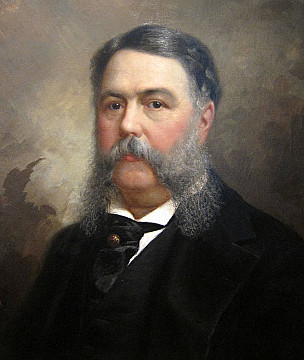
He was preceded in the Presidency by James A. Garfield, stepping in after Garfield was assassinated. He served for the remainder of that term in office for the Republican Party and was succeeded in 1885 by Grover Cleveland. Having originally been Garfield's Vice-President, he served his term without one. Although born in a cabin in Fairfield, Vermont, his family moved frequently and after saving enough money he took himself to New York to study law in 1853 under Erastus Culver. A career lawyer and politician who served as a Brigadier-General in the quartermaster's department during the Civil War, he rose rapidly through the Republican Party ranks after his appointment in 1871 to Collector of Customs for the Port of New York, a lucrative patronage position that made him wealthy and won him important political connections.
He was known as a "Stalwart" Republican who initially supported the "Spoils System" (awarding friends with political appointments after winning office). When Garfield selected him as Vice-President in 1880, it was primarily to balance the ticket and appease the Stalwart faction of the party. As President, Arthur surprised many by championing civil service reform, ending the "Spoils System" by signing the Pendleton Civil Service Act (1883) which established merit-based federal employment. He undertook the then largest ever expansion of the U.S. Navy, vetoed the discriminatory Chinese Exclusion Act (though Congress overrode his veto), and worked to reduce tariffs. His presidency was marked by his transformation from a machine politician to a reformer, though his efforts to secure the Republican nomination in 1884 failed. He died in 1886, just two years after leaving office, having earned respect for his integrity and unexpected independence as president. From 1865 until his death he lived in New York at 123 Lexington Avenue (see images). In 1859, he married Nell Herndon and two of their three children lived to adulthood.
He was known as a "Stalwart" Republican who initially supported the "Spoils System" (awarding friends with political appointments after winning office). When Garfield selected him as Vice-President in 1880, it was primarily to balance the ticket and appease the Stalwart faction of the party. As President, Arthur surprised many by championing civil service reform, ending the "Spoils System" by signing the Pendleton Civil Service Act (1883) which established merit-based federal employment. He undertook the then largest ever expansion of the U.S. Navy, vetoed the discriminatory Chinese Exclusion Act (though Congress overrode his veto), and worked to reduce tariffs. His presidency was marked by his transformation from a machine politician to a reformer, though his efforts to secure the Republican nomination in 1884 failed. He died in 1886, just two years after leaving office, having earned respect for his integrity and unexpected independence as president. From 1865 until his death he lived in New York at 123 Lexington Avenue (see images). In 1859, he married Nell Herndon and two of their three children lived to adulthood.