
Andrew Jackson (1767-1845)
General "Old Hickory" Jackson, 7th President of the United States (1829-1837)
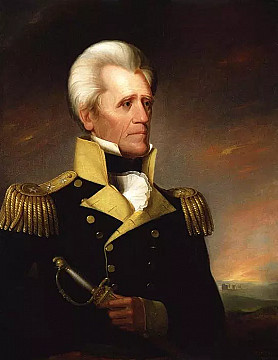
He was preceded in the Presidency by John Quincy Adams and after serving two terms in office for the Democratic-Republican Party he was succeeded in 1837 by Martin Van Buren. His Vice-President during his first term was John C. Calhoun and for his second term he chose Martin Van Buren. The son of Northern Irish (Presbyterian) immigrants, Jackson was born into poverty on the frontier in the Waxhaws region of the Carolinas. He became a self-made man through law, land speculation, and military service. His national fame began with his decisive victory over the British at the Battle of New Orleans in 1815, making him a war hero for which he won the Congressional Gold Medal. He went on to lead several controversial military campaigns against Native American tribes and briefly governed Florida after its acquisition from Spain. Shortly afterwards, he completed the "Jackson Purchase" buying Chickasaw lands for Tennessee.
Jackson's presidency marked the beginning of the modern Democratic Party and expanded executive power significantly. He championed the "common man" against what he saw as corrupt elites, dismantling the Second Bank of the United States and expanding voting rights for white male citizens. His administration was characterized by fierce political battles, including the Nullification Crisis with South Carolina. However, Jackson's legacy is deeply complicated by his role in expanding slavery westward and his implementation of the Indian Removal Act, which led to the forced displacement of thousands of Native Americans along the "Trail of Tears." His presidency fundamentally reshaped the idea of American democracy while simultaneously perpetuating and expanding systems of racial oppression that would define much of the nineteenth century. He and his wife (who died before he took office) adopted three children (sons), two of whom survived to adulthood.
Jackson's presidency marked the beginning of the modern Democratic Party and expanded executive power significantly. He championed the "common man" against what he saw as corrupt elites, dismantling the Second Bank of the United States and expanding voting rights for white male citizens. His administration was characterized by fierce political battles, including the Nullification Crisis with South Carolina. However, Jackson's legacy is deeply complicated by his role in expanding slavery westward and his implementation of the Indian Removal Act, which led to the forced displacement of thousands of Native Americans along the "Trail of Tears." His presidency fundamentally reshaped the idea of American democracy while simultaneously perpetuating and expanding systems of racial oppression that would define much of the nineteenth century. He and his wife (who died before he took office) adopted three children (sons), two of whom survived to adulthood.