
Longue Vue
7 Bamboo Road, New Orleans, Garden District, Louisiana
Completed in 1942 for philanthropists Edgar Bloom Stern (1886-1959) and his wife Edith Rosenwald (1895-1980). Longue Vue is a 48-room classical Greek-revival mansion standing amidst eight acres of exquisite Moorish-influenced gardens, it is certainly one of the most beautiful estates in America.
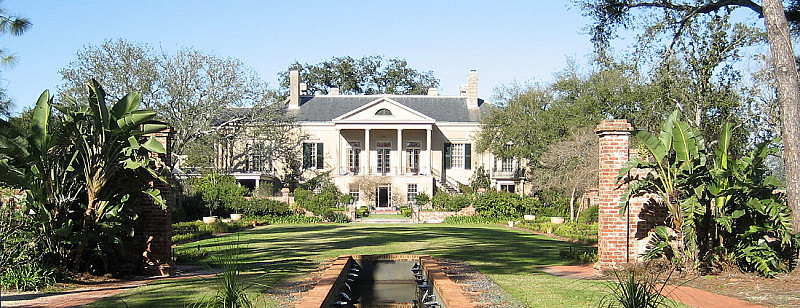
The house is named after the Longue Vue Inn that stood on the Hudson River, where Edgar and Edith became engaged in 1920; however, it is in fact the second of the two houses they built on the property. The first house, with the gardens, was started in 1924, but on it’s completion Edith was disappointed that this house gave only a restricted view of her magnificent gardens. So, in 1939 with the help of some mules, winches and cypress logs, the first house was transported a short distance to the corner of Garden Lane and Metarie Road.
The new house, as seen today, was completed in 1942 and the four facades of the 48-room house each has a different appearance and each gives an uninterrupted view out on to a different garden. Though Greek-revival in style, the three story house is embellished with local touches from old Louisiana plantations that were admired by the Sterns. The rooms within played host to many lively parties and fundraising events during their time, and the house retains it’s original furnishings.
The new house, as seen today, was completed in 1942 and the four facades of the 48-room house each has a different appearance and each gives an uninterrupted view out on to a different garden. Though Greek-revival in style, the three story house is embellished with local touches from old Louisiana plantations that were admired by the Sterns. The rooms within played host to many lively parties and fundraising events during their time, and the house retains it’s original furnishings.
Longue Vue is approached via an avenue of interlacing oaks trained into an arch. The grounds are made up of a formal garden surrounded by a series of smaller gardens, but each with their own character and color scheme. Throughout the estate there are to be found more than 100 varieties of trees and shrubs, many of which were imported.
The largest of the formal gardens is the Spanish Court, influenced by the Palacio de Generalife and Alhambra, both in Grenada, Spain. The oldest of the thirteen fountains founds here is the 15th century dolphin fountain, carved from one block of Sevillian marble.
Mosaic walks and original Spanish sculptures also contribute to the Moorish splendour of the Spanish Court. In the Wild Garden, the paths are carpeted with pine needles that meander through trees, shrubs and flowers native to the Gulf Coast. The pan garden is named for the mythical character whose statue stands at it’s center. The Yellow Garden includes golden blossoms and yellow jasmine, while the terrace is made from unpolished marble and the fountain base of volcanic ash, both from Mexico. Other features include the Whim House, the colonnaded loggia; and the Discovery Garden, Portico Garden and Walled garden are equally designed with sweet-smelling, colourful specimens.
Mosaic walks and original Spanish sculptures also contribute to the Moorish splendour of the Spanish Court. In the Wild Garden, the paths are carpeted with pine needles that meander through trees, shrubs and flowers native to the Gulf Coast. The pan garden is named for the mythical character whose statue stands at it’s center. The Yellow Garden includes golden blossoms and yellow jasmine, while the terrace is made from unpolished marble and the fountain base of volcanic ash, both from Mexico. Other features include the Whim House, the colonnaded loggia; and the Discovery Garden, Portico Garden and Walled garden are equally designed with sweet-smelling, colourful specimens.
Longue Vue Gardens were opened to the public in 1968. After her husband’s death, Mrs Stern remained there until two years before her own demise in 1980. Unsurprisingly, Edith had created a non-profit foundation to maintain the house and gardens after her death for the benefit of the public. The gardens remain open to the public and the house today caters as a museum for the decorative arts.
Categories
Styles
Share
The Jewish Community of New Orleans (Arcadia Publishing, 2005), by Irwin Lachoff, Catherine C. Kahn; The Pelican Guide to the Gardens of Louisiana (1974), by Joyce Yeldell Leblanc; and, Louisiana Gardens (1999), by Mary Fonseca