
Dumbarton House
2715 Q Street, N.W., Georgetown, Washington D.C.
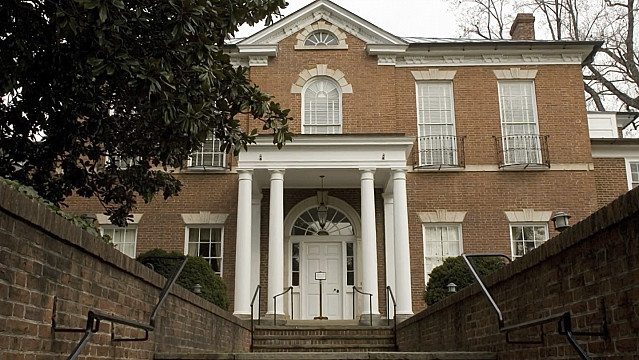
Completed in 1799 for Samuel Jackson (1755-1836), a merchant from Philadelphia. It's a rare example in Washington of what was then the new Federal-style of architecture, influenced by the early Georgian period. Today, it's a popular house museum maintained by the National Society of the Colonial Dames of America....
This house is best associated with...


The large windows and fanlight over the main entrance are features from the original house built in 1799. The central block is flanked by two two-story wings connected by matching hyphens. The interior follows a symmetry typical of the period with rooms of equal size each side of the central passage. The bowed walls extending into the garden are distinctly Federal in style, and though the architecture was cleaner and less elaborate, there is an abundance of finely carved eagles, dolphins, and caryatids, particularly over the doorways. The house is furnished with excellent examples from the Federal-period.
In 1703, Colonel Ninian Beall (1625-1717) of Bacon Hall, Maryland, was granted a tract of 795 acres of land that he named “Rock of Dumbarton” due to a similarity it shared with same named feature in his native Scotland. The land remained in the possession of the Beall family and part of it later fell within boundaries of the newly chartered "George-Town". In 1796, Ninian’s grandson, Thomas Beall, sold four of those acres (on which the house stands today) to Peter Casenave who within two months had flipped it to General Uriah Forrest (1746-1805). The plot changed hands again the following year when it was purchased by Isaac Polack who sold it in 1798 to a developer, Samuel Jackson, who built on it a large “two-story brick house with a passage through the center, four rooms on a floor and good cellars.” Jackson, however, went bankrupt and the new house sat empty 'til 1804.
In 1804, Joseph Nourse purchased Dumbarton House at public auction for $8,581.67 and renamed it “Cedar Hill”. In 1813, he sold it to Charles Carroll of Carrollton who called it “Bellevue” after his former plantation near Hagerstown, Maryland. In 1814, Carroll’s friend, U.S. President James Madison, asked him to persuade his wife, Dolley, to make her escape from the White House as British and Canadian forces marched on Washington with torches at the conclusion of the War of 1812. Carroll succeeded, taking her and Eleanor Young Jones, wife of William Jones (1760-1831), to “Bellevue” before leaving for Virginia.
From 1815 to 1841, the Carroll family leased the house to several tenants. Included among them was the highly decorated U.S. Naval Commodore John Rodgers, who briefly served as U.S. Secretary of the Navy, and from 1820, Samuel Whitall, a wealthy Quaker from Philadelphia who owned a fishery on the Potomac. It was Whitall’s son, Joseph, who purchased the house from Carroll's heirs in 1841 and gave it to his sister, Sarah, on her marriage that year to the banker Charles Edwin Rittenhouse. She renamed it “Rittenhouse Place” and lived there until her death in 1896, when it was sold to Horace Hinckley.
In 1912, the house was purchased by John Lowe Newbold (a great-grandson of the brother of former owner Mrs. Lydia (Newbold) Whitall) and three years later Q Street was extended to the bridge that crossed Rock Creek. Rather than demolish it, the house was lifted onto huge rollers and slowly pulled by horses one hundred yards north of the original site where it still stands to this day. In 1928, the house was purchased by the National Society of the Colonial Dames of America and renamed “Dumbarton House.” The house has been open to the public since 1932 and is still maintained by the Dames.


You May Also Like...


Categories
Styles
Share
Image Courtesy of Library of Congress Prints and Photographs Division Washington, D.C. 20540 USA; https://dumbartonhouse.org/georgetown-1790-1815/